
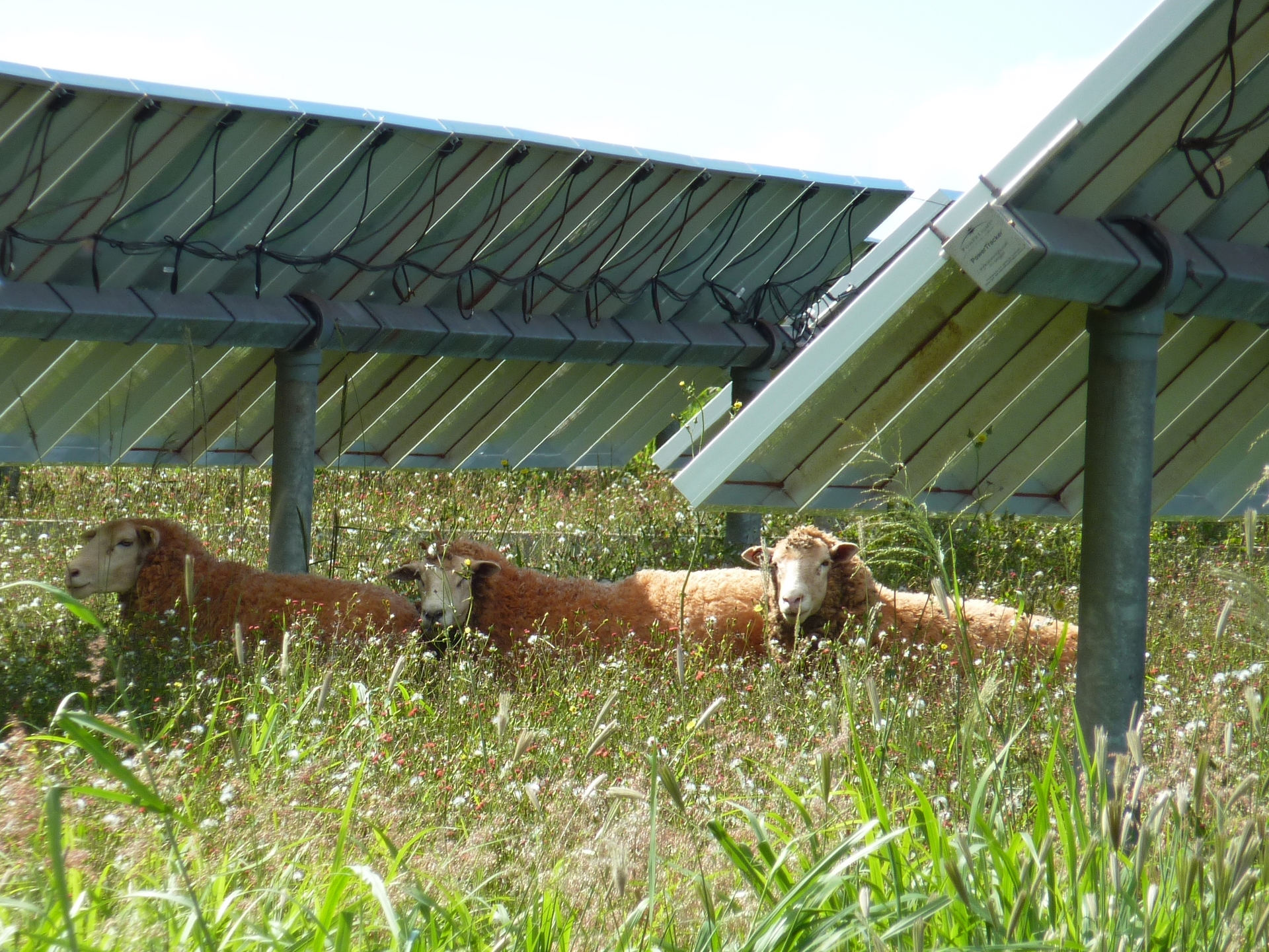
The word sounds like something a botanist and an electrical engineer invented together on a road trip. Agrivoltaics. It is, in fact, exactly that: the practice of installing solar panels on the same land used for crops or livestock, so that a single acre does two productive things at once — generate clean electricity and keep farming.
It's an idea gaining serious scientific traction, and it deserves a clear-eyed look. Because the conversation around it has become unnecessarily muddled — partly by legitimate open questions, and partly by interests that have never had farmers' or the environment's wellbeing as a priority.
What the Research Actually Shows
The intuitive fear is that panels block sunlight crops need. For some configurations, that's true. But partial shade is often more complicated than it sounds. A 2024 MIT-Lincoln Lab study found that chili peppers, strawberries, and eggplant showed yield gains of up to 17% under 35% PV shading. Many crops routinely hit their photosynthetic light saturation point — the level above which more sun doesn't help — and shade reduces thermal stress and water loss instead. In arid regions especially, the water efficiency gains from reduced evapotranspiration can be as valuable as the electricity generated.
Farmers also gain a steady second income stream in an industry defined by volatility. U.S. agrivoltaic installations grew from 27,000 acres and 4.5 GW of capacity in 2020 to over 62,000 acres and 10 GW by 2024. That's not a niche experiment. And a dual-use arrangement often keeps land in agriculture that might otherwise be sold to a warehouse developer or left economically unviable — the alternative to solar-plus-farming is rarely pristine untouched farmland.
In arid regions especially, the water efficiency gains from reduced evapotranspiration can be as valuable as the electricity generated.
The Legitimate Concerns
A fair assessment can't skip the real complications.
Not all crops, climates, or configurations work equally well. Early Cornell research found yields of radish and radicchio dropped nearly 50% inside a tightly spaced array. A 2026 University of Illinois study found that agrivoltaic economics in the Midwest vary significantly by regional aridity — semi-arid areas show clear win-win results, while more humid regions may need policy incentives to make the numbers work. This is a site-specific tool, not a universal fix, and developers who treat it as one do farmers a disservice.
Soil compaction during installation is a genuine risk. Heavy construction vehicles can damage soil structure in ways that take years to reverse — and in some cases, particularly on high-quality agricultural land, may not fully reverse at all. This is not a reason to reject agrivoltaics; it's a reason to demand proper installation standards. Best practices from NREL include minimizing grading, using driven posts instead of concrete footings, and deploying soil decompaction measures after installation. When developers follow these guidelines, the risk drops substantially. When they cut corners, farmers have a legitimate grievance.
As of 2024, most agrivoltaic sites are still the simpler model — native grasses, pollinator habitat, or sheep grazing beneath panels — which is well understood and widely successful. Crop integration under panels is more complex and still an active research area. That honesty matters.
The Noise That Isn't About Farming
Here's where it's worth being direct. The concerns above are real, but they're answerable — with better installation standards, site-specific planning, and continued research. They are not fatal flaws in the concept. And yet opposition to solar on farmland is often far louder than those nuances warrant.
Organized opposition, often funded by fossil fuel interests, has documented involvement in stoking resistance to rural renewable energy development. Much of the culture-war framing around "solar taking over farmland" flows from that same pipeline — not from farmers worried about their soil.
Those are different conversations. Farmers with genuine questions about compaction and crop yields deserve real answers — not talking points written by people who would prefer we keep burning fossil fuels indefinitely. And they tend to respond well to honest information: research shows that when rural communities learn concrete facts about solar productivity, support increases noticeably.
The Bottom Line
Agrivoltaics is not magic. Wrong crop, wrong configuration, wrong climate — you'll get suboptimal results for everyone. The science on row crop integration under panels is still maturing, and soil management during installation requires genuine care.
But the core proposition is well-supported: the same acre can grow food and generate electricity, farmers can benefit financially while keeping land in agricultural use, and done correctly it's better for the climate than the alternative of doing nothing. The USDA, DOE, and NREL are all investing in it. Japan has over 3,000 installations. Germany, France, Italy, China, and India have commercial-scale deployments.
Yes we can, and should, do this.


