
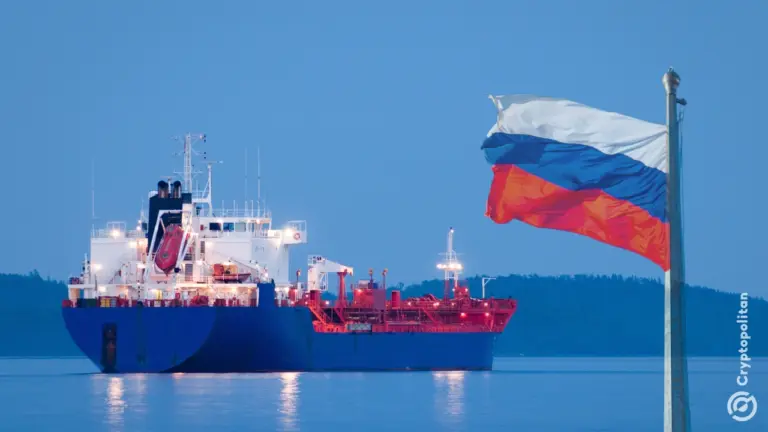
By early May 2026, more than 1,550 commercial vessels and 22,500 mariners were stranded in and around the Strait of Hormuz. US gasoline hit $4.52 a gallon. The IMF used the phrase "close call for global recession" in an official publication. Forty-five million people may face life-threatening food insecurity before this is over. The coverage of all of this is voluminous. The losers are easy to find.
What's harder to find — buried under shipping data, ceasefire negotiations, and oil-price charts — is any serious discussion of who isn't losing. That answer is Russia. And the omission deserves its own examination.
The Setup
Since Iran effectively closed the strait in early March, traffic has collapsed to under five percent of pre-war volumes. The IEA called it "the largest supply disruption in the history of the global oil market" — roughly 14 to 14.5 million barrels per day knocked offline, alongside about 20 percent of global LNG. Brent peaked at $126 per barrel. European gas doubled. Qatar declared force majeure on LNG deliveries to Italy, Belgium, South Korea, and China. The bypass pipelines max out at less than half of normal Hormuz throughput, and both have been hit by Iranian drones. There is no pipeline alternative for LNG at all.
Follow the Money to Moscow
Russia exports roughly 7 to 8 million barrels of crude per day through routes entirely unaffected by this closure — Baltic ports, Arctic terminals, pipelines into China and Turkey. It does not import Gulf oil. The humanitarian emergency grinding down Bangladesh, Sri Lanka, and Gulf states does not reach Moscow in any comparable way.
What does reach Moscow is the price signal. Russia's Urals crude trades at a structural discount to Brent — a penalty Russia has lived with since 2022 sanctions. When Brent was sitting at $70 to $80, that discount hurt. When Brent hits $100 to $126, Russia's revenue per barrel climbs sharply even with the discount applied. The Russian federal budget requires roughly $60 to $70 per barrel to balance. The Hormuz crisis delivered sustained comfort above that threshold without Russia doing anything at all.
The LNG picture is even less discussed. Russia is a major LNG producer — and Qatar is its primary competitor for European and Asian contracts. Damage to Qatar's Ras Laffan complex from Iranian strikes is estimated to take three to five years to fully repair, potentially removing up to 120 billion cubic meters of LNG from global markets through 2030. That is not a temporary inconvenience for Russia's energy export position. That is a competitor being structurally weakened for half a decade. Russian pipeline gas and Arctic LNG projects gain relative to Qatari supply that has been, at least partly, bombed off the field.
These aren't coincidences that require a conspiracy theory to explain. They are the natural result of aligned interests.
The Geopolitical Dividend
The financial case is substantial on its own. The strategic case compounds it.
The United States has a carrier group running escort operations that got paused after Iranian missile strikes, a Strategic Petroleum Reserve being drawn down at historic rates, and a ceasefire negotiation Trump publicly called "totally unacceptable" as of May 10. Washington is not maximally focused on eastern Ukraine right now, nor on weapons deliveries, sanctions enforcement, or the diplomatic architecture keeping Russia under economic pressure.
Meanwhile, Iran is allowing Russian-flagged vessels through the strait under bilateral arrangements while Western carriers face the blockade. The new Persian Gulf Strait Authority — established May 5 and being built as a permanent institution — is quietly assembling a trade architecture around yuan-denominated transactions and bilateral tolling agreements. That happens to align well with the alternative financial system Russia has been constructing since 2022 to route around dollar-denominated sanctions.
These aren't coincidences that require a conspiracy theory to explain. They are the natural result of aligned interests.
The Question Nobody Is Quite Asking
To be clear: there is no public evidence that Russia orchestrated this war. The internal dynamics of the US-Iran-Israel conflict are more than sufficient to explain how it started. The question worth asking is different and more uncomfortable: does Russia want this to end?
The longer the strait stays closed, the more revenue Russia collects. The longer Qatar's LNG infrastructure stays damaged, the stronger Russia's competitive position in European energy markets. The longer the US is consumed by Gulf crisis management, the lighter the pressure on Russia's western front. Russia has genuine influence over Iran — arms sales, UN Security Council cover, economic partnerships built over four years of mutual sanctions. What Russia is quietly encouraging, or not discouraging, in back-channel negotiations barely registers in Western coverage. That gap is worth noticing.
The Bottom Line
The Hormuz crisis is causing real suffering at global scale. The economic analysis is serious and the humanitarian stakes are real. But serious analysis of any crisis includes asking who benefits and whether that beneficiary has influence over the outcome. Russia benefits more clearly than almost any other actor — in revenue, in competitive positioning, in geopolitical distraction value, and in the alternative economic architecture it has been building for years. Whether Russia wants this resolved isn't the same as accusing Russia of starting it. It's just the obvious question — and the fact that it's rarely asked is itself worth examining.


