
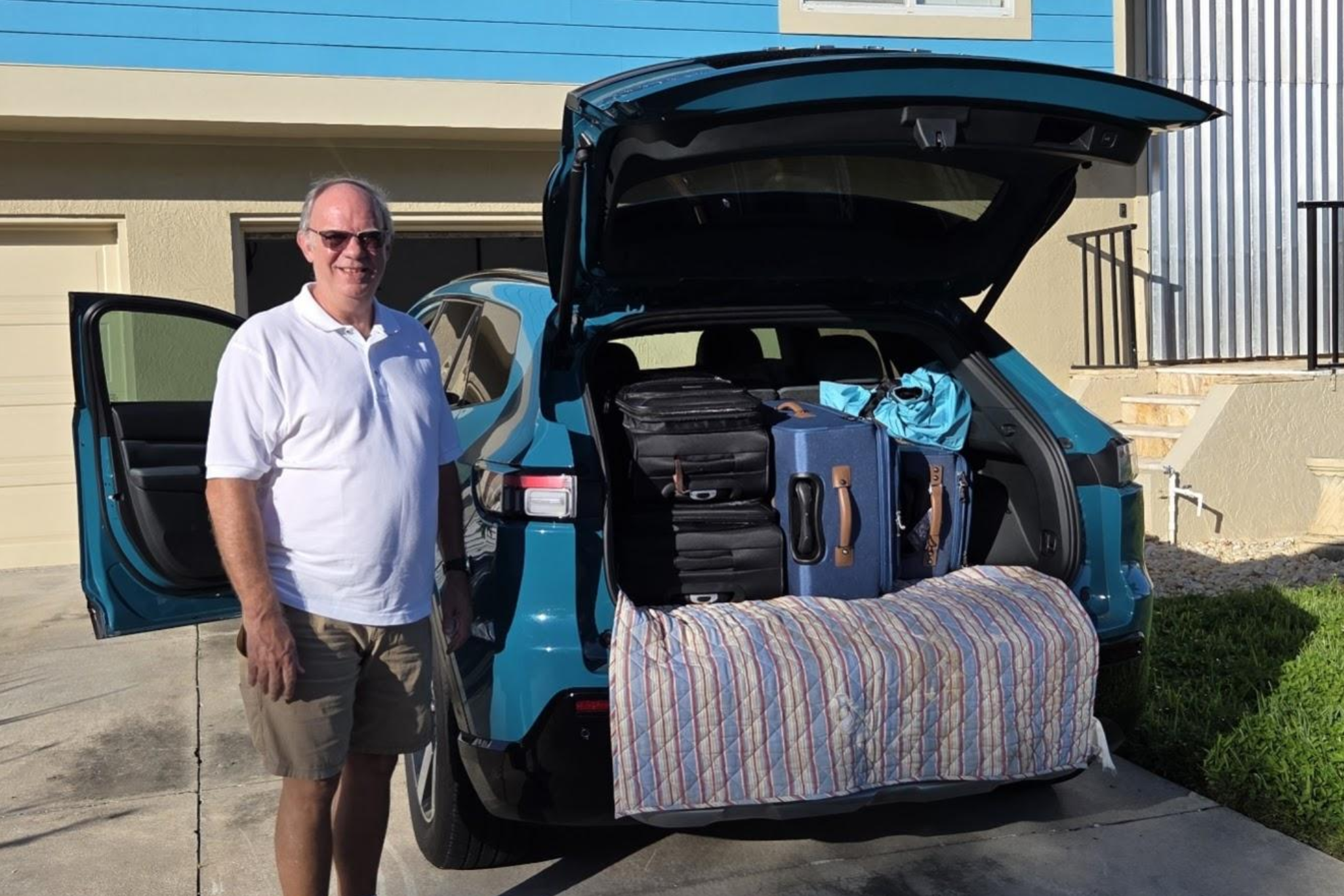
The short answer is yes, EV road-tripping works. The longer answer involves a Philadelphia hotel that doesn't actually have EV charging, a month in Nova Scotia that reset our thinking on range anxiety, and a final charging bill of $344 versus roughly $1,025 for gas.
Charging Hiccups
Despite real improvements to charging infrastructure in recent years, there WERE some issues — although none were catastrophic. On one occasion it was user error: you have to pay attention to charging speed if units on the same station differ. I plugged into the slower one and it extended our charge time. There were also a couple of equipment failures — an EVgo unit quit mid-charge and a Tesla plug had broken pins. In both cases we simply switched to another unit and carried on.
The one genuine frustration was an outright failure to charge at all in Philadelphia. Even with tech support on the phone, nothing worked. The culprit? The hotel advertised EV charging — but it was in an offline parking garage across the street that the hotel had no control over. That's not EV charging. That's a parking garage nearby. I wrote to Hotels.com about it. They promised to look into it; I won't hold my breath.
Charging Where You Stay
For years we've made a point of booking accommodations with EV charging. It's getting easier, but the Philadelphia situation shows why you still need to verify claims directly. On this trip I called several places ahead of time. At one spot the host was waiting for us and had put out an "EV Parking Only" sign. At another, the host tracked down the driver blocking the EV spot and had them move. That's the kind of service that makes the difference.
Charging at accommodations is sometimes free, though less often than it used to be. A fee is fine — the key is knowing it will actually be available to you as a guest, not just a public charger you have to compete for. At larger hotels with only one or two units, don't count on them being free in the morning.
Of the 14 paid overnight stays on this trip, 10 had EV charging available — and that's not counting the Philadelphia hotel.
The biggest win of the trip was spending a full month at a rental house in Nova Scotia with a flawless home charger at no extra cost. We took day trips constantly without a second thought about charging. Only once did we need a brief top-up to make it back. Every morning: 100%.
Range Reality
Our Honda Prologue has a real-world range of about 280 miles on a full charge, with roughly a 10% buffer kept in reserve. For day trips, that's plenty. On longer road stretches, the practical number is closer to 220 miles — because you're typically working with 70% of the battery (charging to 80%, leaving 10% at the bottom). That 220-mile figure is the one that should be in every EV range conversation, not the theoretical maximum.
There's also an important distinction between battery-to-wheels and wall-to-wheels efficiency that rarely gets discussed. Battery-to-wheels is what the car reports — how far you go per kWh consumed from the battery. Wall-to-wheels accounts for charging loss, meaning you pay for more energy than the battery actually delivers. On this trip our battery-to-wheels was 3.68 miles/kWh, but wall-to-wheels was 3.31 miles/kWh. When comparing EV costs to gas, wall-to-wheels is the honest number to use.
Trip at a Glance
| Total distance | 6,268 miles |
| Total charging cost (with credits) | $344.43 |
| Equivalent gas cost (26 mpg @ $4.25/gal) | $1,024.58 |
| Battery-to-wheels efficiency | 3.68 mi/kWh |
| Wall-to-wheels efficiency | 3.31 mi/kWh |
| Total charge sessions | 43 |
The Bottom Line
Can you do a road trip in an EV? Yes — emphatically. This trip cost us $344 in charging versus roughly $1,025 for a comparable gas vehicle. That's real money, and it compounds over every trip you take. The charging infrastructure isn't flawless, but it's functional. Plan your stops, verify your overnight charging before you book, and understand your actual usable range. Do those three things and you'll be fine.
Happy road tripping.


